How human gaze shapes attention, trust, and buying behavior
The Psychology of Human Gaze
Before the headline is read, before the product is evaluated, before the click happens, the face often wins the first moment of attention.
But attention does not stop there.
Once a person notices a face, the eyes can redirect what happens next — toward the viewer, toward the product, or toward the message itself.
That movement is subtle enough to go unnoticed.
Yet it can influence what receives attention, what gets remembered, and what feels trustworthy.
In advertising and ecommerce, that makes one small creative decision more important than it seems:
Where should the human look?
Why We Follow Eyes
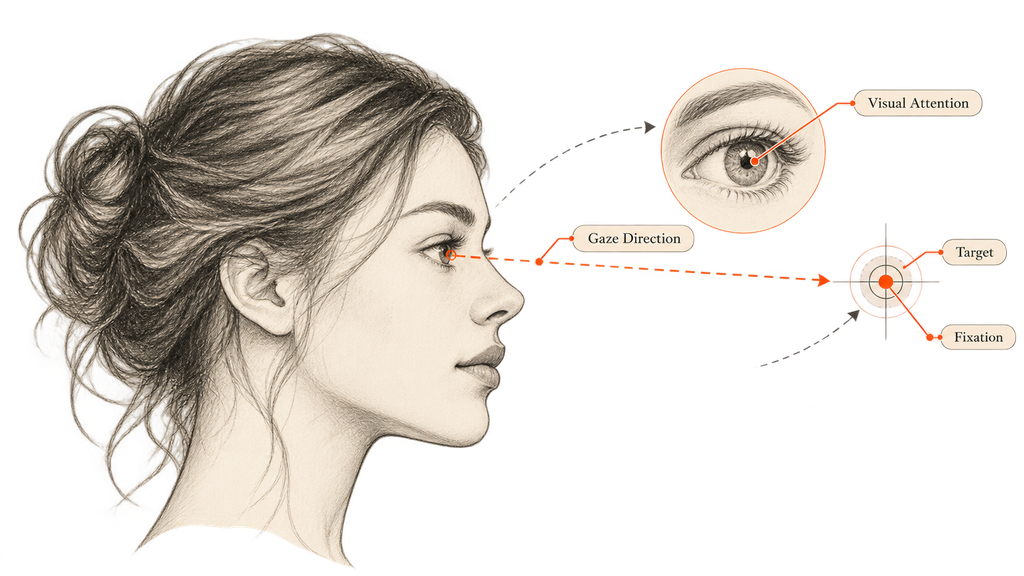
Humans are unusually sensitive to where other people are looking.
A shift in someone else’s gaze can redirect our attention almost automatically — even when that gaze does not predict where something important will actually appear.
Psychologists call this effect gaze cueing.
It is closely related to joint attention: the ability to align our attention with another person and focus on the same object, event, or location.
This mechanism develops early in life and plays a role in social learning, communication, and understanding what other people consider important.
In a visual environment, that means a pair of eyes can act like a directional signal.
Not because the viewer is consciously following an instruction.
But because the brain is constantly asking:
What are they looking at — and should I look there too?
The face captures.
A human face can win attention before the viewer has consciously processed the rest of the scene.
The face becomes the first visual anchor — the point where attention initially lands.
Human presence can become the first meaningful object the viewer notices.
The gaze routes.
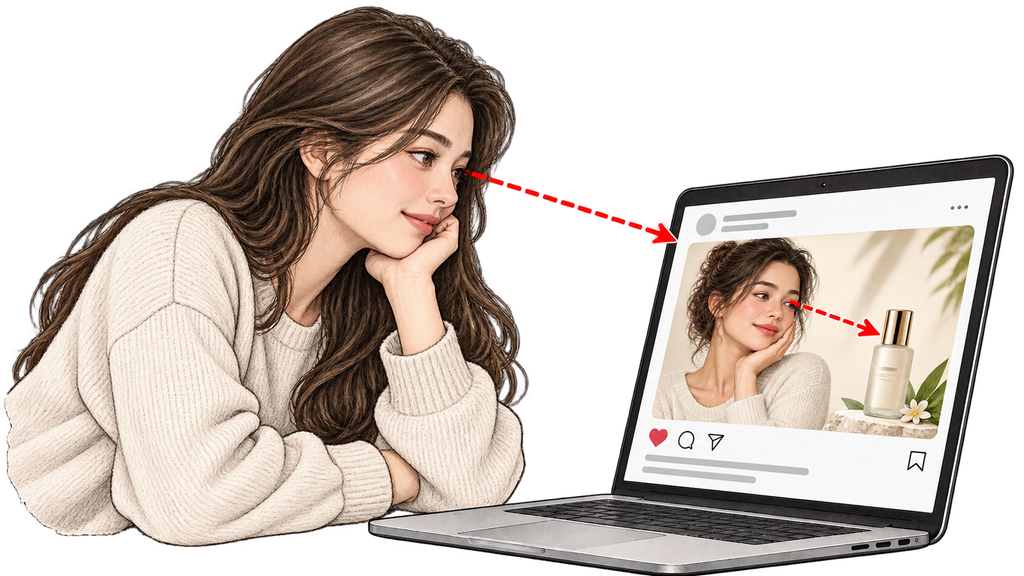
Once attention reaches the face, the eyes can influence where it moves next.
A glance toward a product, message, or CTA can transform the human element from a visual anchor into an attention guide.
Stopping attention is not the same as directing it.
A creative can successfully stop the scroll and still fail to guide attention toward the product or message.
Where did the attention go next?
Capturing attention is one job. Routing it is another.
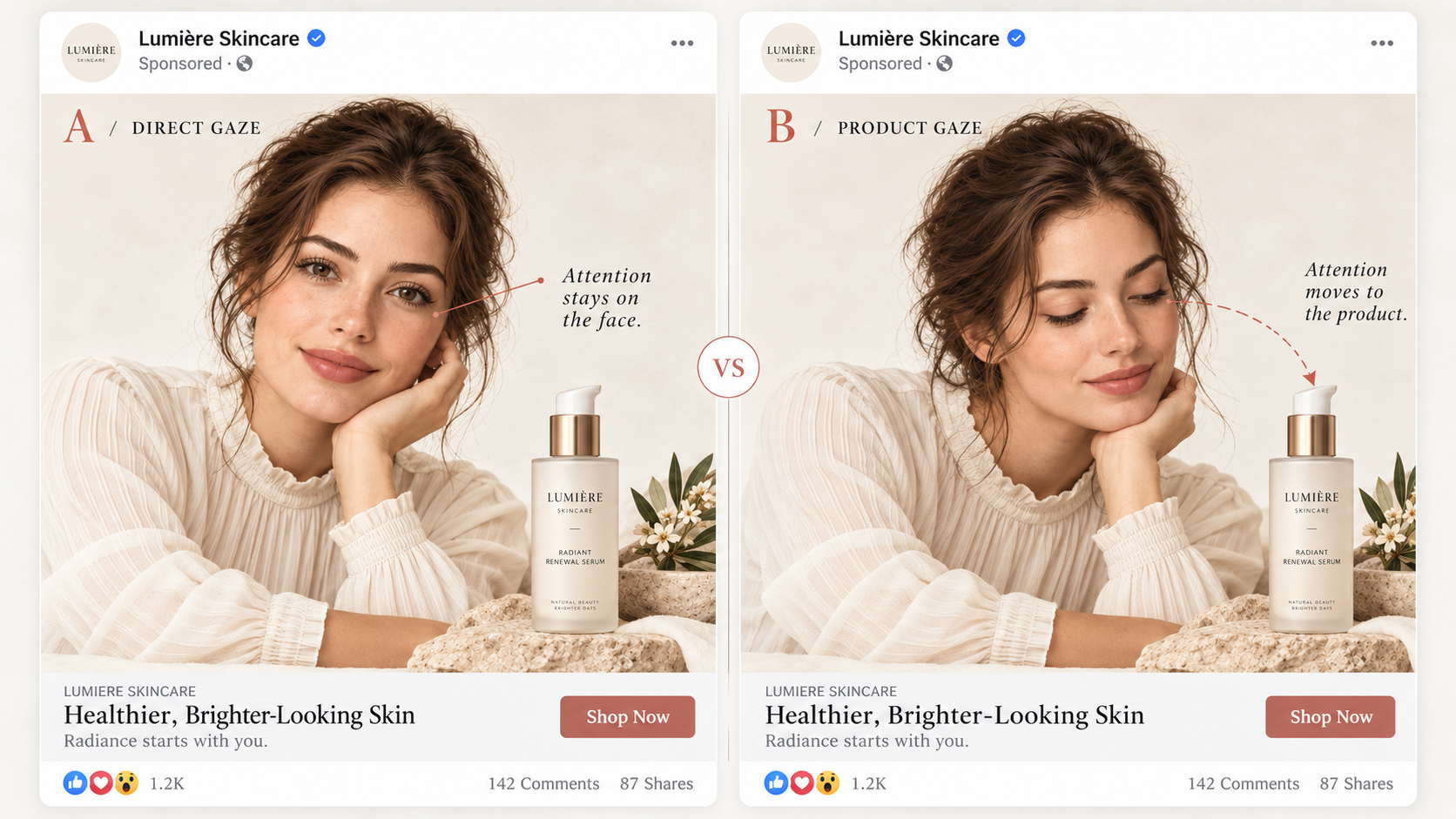
Look at Me vs. Look at the Product

Direct gaze and product-directed gaze do not do the same job.
When a person in an ad looks directly at the viewer, attention tends to stay on the human. The face becomes the social center of the visual.
But when that same person looks toward the product, attention can shift with them.
Eye-tracking research has repeatedly shown that viewers are more likely to inspect the object being looked at — and often spend more time processing the product, logo, or surrounding message.
That creates two very different creative outcomes:
Direct gaze says:
“Look at me.”
Product-directed gaze says:
“Look where I’m looking.”
Neither is automatically better.
The right choice depends on what the creative needs to achieve.
If the goal is connection, credibility, or direct communication, looking at the viewer may help.
If the goal is to move attention toward the product, offer, headline, or CTA, directing the model’s gaze toward that element can become part of the visual hierarchy.
The difference is small.
But the path of attention can be completely different.
The model can be the destination — or the guide.
What the Experiments Actually Found
What eye-tracking, psychology, and advertising research reveal about where attention actually goes.
More likely to look at the product when the model looked toward it.
In one eye-tracking experiment with 137 participants, the odds of looking at the product area were over four times higher when the model’s gaze was directed toward the product.
The same study did not find significant differences in willingness to pay or perceived product attractiveness.
Attention volume is not the same as attention placement.
An ad may attract attention and still direct that attention toward the wrong element.
Gaze direction is not decoration. It is an experimental variable.
When Direct Gaze Wins
Looking at the product can help guide attention.
But direct eye contact can do something different — and sometimes more valuable.
When a person looks directly at the viewer, the visual becomes more socially immediate.
It can feel less like:
“Here is something to notice.”
and more like:
“I’m talking to you.”
That distinction matters.
Direct gaze can strengthen:
- perceived presence
- spokesperson credibility
- social connection
- interpersonal involvement
- the feeling that the message is personally addressed to the viewer
This is especially relevant when the person is part of the message, not just a visual device.
For example:
A founder introducing a product.
An expert explaining a benefit.
A customer giving a testimonial.
A spokesperson delivering an informational message.
In those situations, moving attention away from the person too aggressively may weaken the thing the creative is trying to build:
trust in the person speaking.
Research on advertising gaze direction also suggests that context matters.
Averted gaze can work well when the viewer needs to become immersed in a scene or follow attention toward something else.
Direct gaze can become more useful when credibility, communication, and interpersonal connection are central to the message.
So the decision is not:
Direct gaze or product gaze?
It is:
What is the human supposed to do in this creative?
Are they the guide?
Or are they the message?
If the person is the source of trust, their face may deserve the attention.
When Direct Gaze Wins
The right gaze depends on the role the human is playing in the creative.
Is the human the message — or the guide?
The gaze should follow the role.
From Gaze to Conversion
The psychology only matters if it changes what you design, test, or optimize.
Use gaze to control the first attention path.
If the product or offer needs to be noticed quickly, let the person’s gaze help move attention toward it.
Make the human support the hierarchy.
The face should not compete with the headline, CTA, or offer if those elements need to carry the decision.
Keep the product as the destination.
Lifestyle imagery should strengthen product discovery, not turn the model into a visual dead end.
Let the person carry the trust.
When the human is the evidence, direct gaze can help the message feel more personal and credible.
Treat gaze like a testable variable.
Keep the person, product, layout, copy, and scale fixed. Change only the gaze direction.
Decide what deserves the attention.
If the person is the source of trust, keep attention on them. If the object or message is the goal, use the human to guide attention toward it.
There is no universal gaze direction that wins every creative.
Don’t trust the rule.
Test the gaze.
Research & References
Visual attentional orienting by eye gaze: A meta-analytic review of the gaze-cueing effect
https://pubmed.ncbi.nlm.nih.gov/35404635/
Judgments at Gaze Value: Gaze Cuing in Banner Advertisements
https://pmc.ncbi.nlm.nih.gov/articles/PMC5454066/
How the Eyes Connect to the Heart: The Influence of Eye Gaze Direction on Advertising Effectiveness
https://academic.oup.com/jcr/article-abstract/48/1/123/6050834
The Developmental Origins of Gaze-Following in Human Infants
https://onlinelibrary.wiley.com/doi/10.1111/infa.12276
Should new online stores invest in social presence elements? The effect of social presence on initial trust formation
https://www.sciencedirect.com/science/article/pii/S0969698914000344
Consumer trust in B2C e-Commerce and the importance of social presence
https://www.sciencedirect.com/science/article/pii/S0305048304000131